Stephen Reeder
Director of Marketing
E-mail

A tenant says their unit was locked when they arrived, but your records show access activity at the gate an hour earlier. That gap between site entry and unit-level accountability is where a smart latch becomes valuable. For self-storage operators, unit security is not just about putting hardware on a door. It is about knowing who accessed what, when, and whether your system supports the way the facility actually runs.
A smart latch is a unit-level locking component designed to add control, visibility, and accountability beyond a traditional hasp and padlock setup. In a self-storage environment, that matters because perimeter security alone does not tell the full story. A gate event confirms site access. It does not confirm whether a specific unit was opened, whether it remained unsecured, or whether staff needed to intervene.
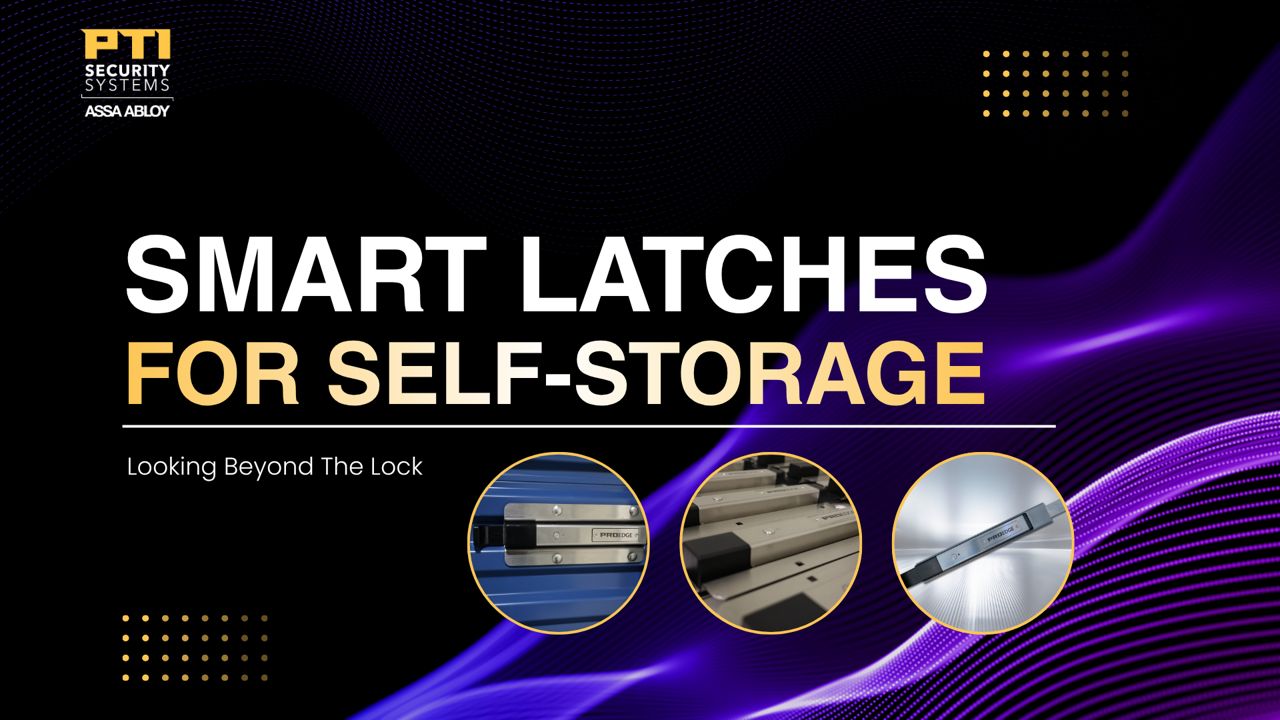
That is the core operational value. A smart latch, such as the ProEdge Smart Latch by PTI Security Systems, helps connect site access with unit activity, giving operators a clearer picture of what is happening at the door itself. For facilities managing risk across dozens, hundreds, or thousands of units, that added layer can support faster response, better records, and stronger control over day-to-day access.
Many facilities still rely on conventional locking methods because they are familiar and relatively simple. There is nothing wrong with simple hardware when the site profile is small and management demands are limited. But as facilities scale, the limits become more obvious.
A standard lock does not provide operational intelligence. If a unit is left unsecured, damaged, or accessed outside expected patterns, staff often find out only after a tenant reports a problem or during a physical walk of the property. That delay creates exposure. It can also create costly disputes when there is no clear event history tied to the unit.
The issue is not that traditional locks never work. The issue is that they do very little beyond basic physical deterrence. Modern self-storage operations need more than deterrence. They need verification, status awareness, and a practical way to support both tenant access and site oversight.
The real benefit of a smart latch is not just smarter hardware. It is the role that hardware plays within an access control system built for self-storage. When unit-level locking works as part of a connected security approach, operators gain more than a secured door.
They can monitor whether a unit is locked or unlocked. They can associate access activity with a credential or event trail. They can reduce dependence on manual checks for every exception. And they can create a more consistent security process across the site.
For single-site owners, that may mean tighter control with less day-to-day uncertainty. For multi-site operators, it can mean more standardized security across the portfolio. The difference is important. A smart latch has the most value when it supports operational consistency, not when it is treated as a standalone gadget.
Self-storage security works best in layers. Gate access, facility entry points, surveillance, alarms, software, and unit-level protection each serve a purpose. A smart latch strengthens one of the most important layers because it addresses the actual rented space.
That matters for both security and customer experience. Tenants expect the facility to control who comes onto the property, but they also expect their individual unit to be protected in a way that reflects professional facility management. If a site can verify gate entry but cannot account for unit access conditions, the security story is incomplete.
Not every facility needs the same setup, and not every smart latch deployment will deliver the same return. The right fit depends on how the site operates.
Start with the facility layout. An urban multi-story property has different needs than a drive-up site with wide unit distribution. Environmental conditions also matter. Hardware exposed to weather, dust, and frequent use must hold up over time without creating a maintenance burden that offsets the security benefit.
Then look at integration. A smart latch should support the broader access control environment, not create another disconnected system to manage. If staff must jump between platforms, reconcile manual records, or perform workarounds just to understand access activity, the operational gain shrinks quickly.
You should also consider exception handling. What happens if a tenant forgets credentials, if a unit must be secured after an issue is found, or if delinquency procedures require restricted access? The system should help staff respond cleanly. Security hardware is only as useful as the process it supports when something unusual happens.
A smart latch is not a universal answer for every property, and operators should assess it with a clear view of the trade-offs. Compared with conventional locks, connected unit security can involve higher upfront investment, more planning during deployment, and tighter expectations for system management.
That said, lower-cost hardware is not always lower-cost in practice. If traditional setups lead to recurring labor for manual checks, weak audit trails, tenant disputes, or inconsistent security enforcement, the apparent savings may not hold over time. The right evaluation is not just purchase price. It is the total operational effect.
There is also the issue of scale. On a smaller property with limited traffic and strong on-site oversight, a simpler approach may still be workable. On a larger property or portfolio where access events, staffing, and risk are harder to manage manually, a smart latch can become much easier to justify.
One of the most common mistakes in security upgrades is focusing on the device instead of the deployment. A smart latch performs best when the surrounding system is designed for the facility's workflow.
That includes how credentials are issued, how alerts are managed, how staff monitor events, and how unit status is incorporated into daily operations. It also includes training. If on-site teams do not understand how to use the system consistently, even strong technology can underperform.
For that reason, operators should look for partners that understand self-storage as an operating model, not just as another place to install hardware. PTI Security Systems has long positioned security as part of how a storage facility functions day to day, and that perspective matters when unit-level control is part of the plan.
Tenant expectations have changed. So have operator responsibilities. Facilities are asked to do more with fewer gaps, better records, and stronger consistency across locations. At the same time, portfolios are growing, staffing models are changing, and remote management is more common.
In that environment, blind spots become more expensive. When unit security is disconnected from the rest of the access control strategy, operators may still have a protected site, but they do not have full operational visibility. A smart latch helps close that gap by making the unit door part of the security conversation instead of a separate question mark.
That does not mean every property should move in the same direction on the same timeline. It means operators should look at unit-level control as a business decision, not just a hardware choice. The right solution is the one that improves accountability, supports staff, and fits the actual risk profile of the facility.
A smart latch is most effective when it helps you run a more controlled property, not just a more complex one. If your current setup leaves too much to manual checking, assumption, or after-the-fact investigation, it may be time to look more closely at what unit-level intelligence can do for your operation.