Stephen Reeder
Director of Marketing
E-mail

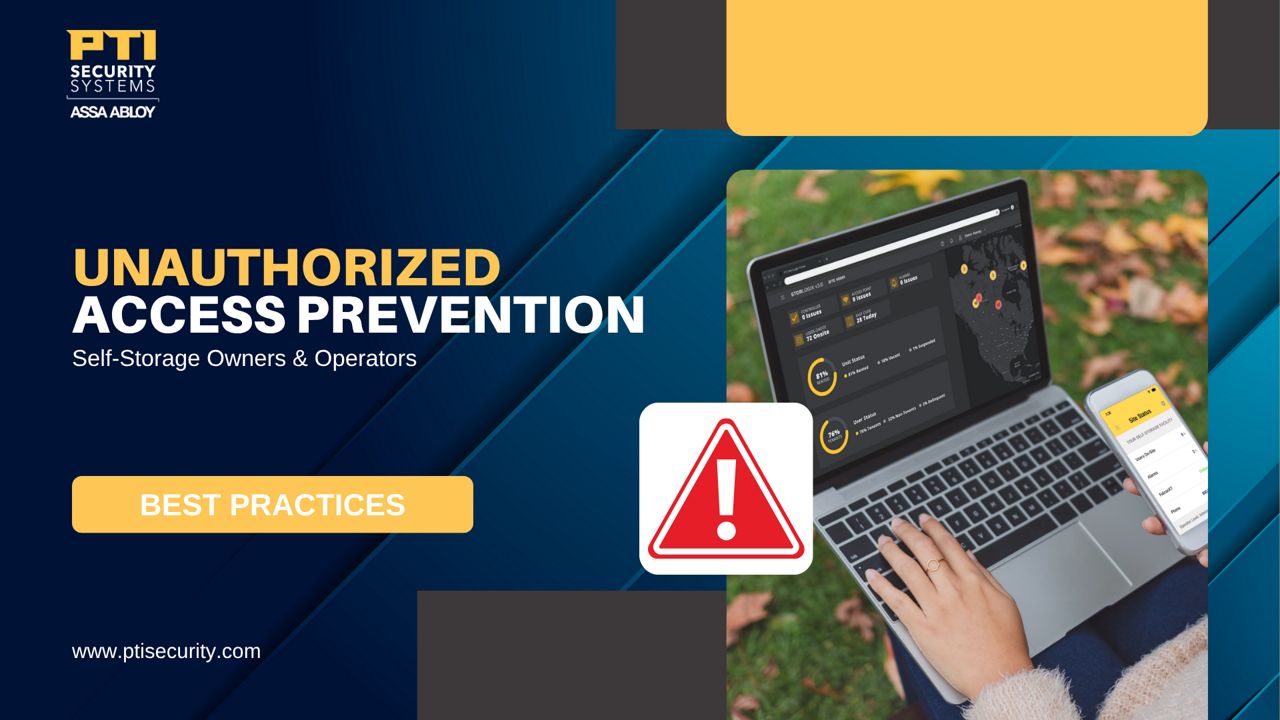
A storage site can look secure on paper and still have blind spots that invite the wrong people in. Gates, cameras, and locks matter, but unauthorized access prevention for self storage is really an operational discipline. It depends on how access is granted, how activity is tracked, how unit-level events are handled, and how quickly staff can respond when something does not look right.
For owners and operators, that distinction matters. Most access problems do not start with a dramatic breach. They start with a shared gate code, a tailgating vehicle, an unsecured hallway door, a former tenant whose credentials were not removed, or a unit alarm that is treated like background noise. Small control gaps create larger exposure over time, especially at unmanned or lightly staffed properties.
Self-storage has a different risk profile than most commercial properties. Customers need recurring access, often outside traditional business hours. Vendors and staff may need controlled entry to specific areas. Some sites have multiple buildings, elevators, interior corridors, and perimeter entry points that create more places for access rules to break down.
The common failure is treating the property as if one gate solves the problem. It does not. A front gate only controls one layer of movement. Once someone is on site, the real questions begin. Can they enter only during approved hours? Can they access only the areas tied to their unit? Can staff confirm where they went and when? Can the system distinguish a valid entry from suspicious movement that should trigger action?
That is why unauthorized access prevention for self storage works best as a layered system, not a single device purchase. Each layer should reduce opportunity, increase visibility, and support daily operations without creating friction for legitimate tenants.
Access control is the foundation because it determines who gets in, when they get in, and what happens after entry. Generic systems often stop at opening a gate. Self-storage operations need more precision.
At a minimum, entry credentials should be unique to each tenant and connected to account status, access hours, and location permissions. Shared credentials weaken accountability. If multiple people use the same code, incident review becomes guesswork. Unique credentials create an audit trail and make it easier to disable access immediately when payment status changes, a move-out is completed, or suspicious activity is identified.
Facility layout should also shape access design. An exterior drive-up property has different control points than a multi-story interior site. Interior sites usually need gate control, building entry management, elevator permissions, and area-specific restrictions. If a tenant rents a unit on the second floor, the system should not give open access to unrelated areas of the property.
This is where operators often see the gap between basic security and purpose-built security. The goal is not just to let people in. The goal is to control movement through the site in a way that reflects how self-storage actually works.
A tenant can enter the property legitimately and still create a security event. That is why perimeter access alone is not enough. If you want stronger unauthorized access prevention for self storage, unit-level visibility matters.
Door alarms are especially valuable because they connect activity at the individual unit to the access system. When a tenant with valid credentials enters the site and accesses their own unit, that event fits the expected pattern. When a unit door opens without corresponding authorized site access, or when activity occurs at unusual times or in conflict with account status, staff gain a clearer signal that something needs attention.
This also improves incident resolution. Without unit-level data, operators may know that someone entered the property but not which unit was affected or whether access was legitimate. With alarm integration, the picture becomes more precise. That precision helps reduce false assumptions, improves follow-up, and supports tenant confidence.
There is a practical trade-off here. More visibility can create more events to manage, so the system has to be configured intelligently. If alerts are constant and non-specific, staff begin to ignore them. Effective security is not about generating more noise. It is about producing usable information tied to clear response procedures.
Cameras are often the first upgrade operators consider, and they are important, but they should not be treated as the core strategy. Video is strongest when it supports access control and alarm activity rather than operating as a standalone record.
A camera system can help verify who entered, whether a vehicle tailgated through the gate, and what happened near a unit or hallway. But if operators have to search hours of footage without timestamps tied to access events, video becomes labor-intensive and reactive. Integrated visibility is more useful because it narrows the review process and helps staff validate an event quickly.
Camera placement also matters more than camera count. Entry lanes, pedestrian doors, elevators, hall intersections, and unit corridors typically provide more value than broad views with limited detail. For many facilities, a smaller number of well-positioned cameras delivers better operational results than a larger system with poor coverage design.
Most unauthorized access issues come from a predictable set of weak points. Tailgating at the gate is one of the most common. If one credential opens the property to multiple vehicles, accountability drops immediately. The same goes for building doors that are propped open, shared tenant codes, and access credentials that remain active after account changes.
Former employee access is another recurring problem. Staff turnover, vendor changes, and role changes can leave permissions in place longer than they should be. A strong process for credential management is just as important as the hardware itself. If access rights are not reviewed and updated consistently, the system loses credibility.
Sites with mixed-use traffic also need careful planning. Delivery personnel, contractors, and temporary vendors may need limited access, but they should not receive the same permissions as full-time staff. Time-based and area-based restrictions help reduce exposure while still supporting maintenance and operations.
Even strong systems fail when site teams do not have clear operating rules. Technology should support policy, not replace it.
That starts with basic standards. Every credential should be assigned to a specific user. Account delinquency rules should be linked to access privileges. Staff should know how to handle tailgating reports, suspicious loitering, after-hours activity, and alarm exceptions. If a unit alarm triggers, the next steps should be defined before the event happens.
Multi-site operators benefit from standardized rules across the portfolio, but there is still room for property-level adjustment. A high-density urban facility may need tighter pedestrian access controls than a rural drive-up site. A site with extended access hours may require more active monitoring than one with limited entry windows. Standardization is valuable, but it should not ignore site conditions.
Unauthorized access risk grows when security systems become inconsistent across locations. Different credential methods, disconnected alerts, and uneven reporting make it harder to maintain control across a portfolio.
Scalable access management helps operators apply consistent standards while still accounting for differences in property design. Centralized oversight can improve credential control, reporting, and event review, especially for organizations managing multiple facilities. It also supports expansion. A security program that works at one site but becomes difficult to manage at five or ten sites will create operational drag.
This is one reason many operators look for self-storage-specific platforms rather than broad commercial systems. The right fit is not just about security features. It is about whether the system supports tenant access workflows, unit-level monitoring, and portfolio management without adding unnecessary complexity. PTI Security Systems operates in that category-focused space because self-storage has its own operational demands.
Effective prevention is usually not dramatic. It looks like credentials that stop working when they should. It looks like a tenant entering only the areas they are authorized to access. It looks like a unit alarm event that can be verified quickly. It looks like staff reviewing meaningful alerts instead of chasing vague ones.
Most of all, it looks like control that holds up during routine operations. Because that is where real risk lives - not only in major incidents, but in the daily exceptions that test whether the property is actually secure.
If you are evaluating your current setup, the best next step is not asking whether you have security. It is asking whether your system can identify, limit, and document unauthorized movement across the entire site. When that answer is yes, prevention becomes part of the operation, not just a line item on the property plan.