Stephen Reeder
Director of Marketing
E-mail

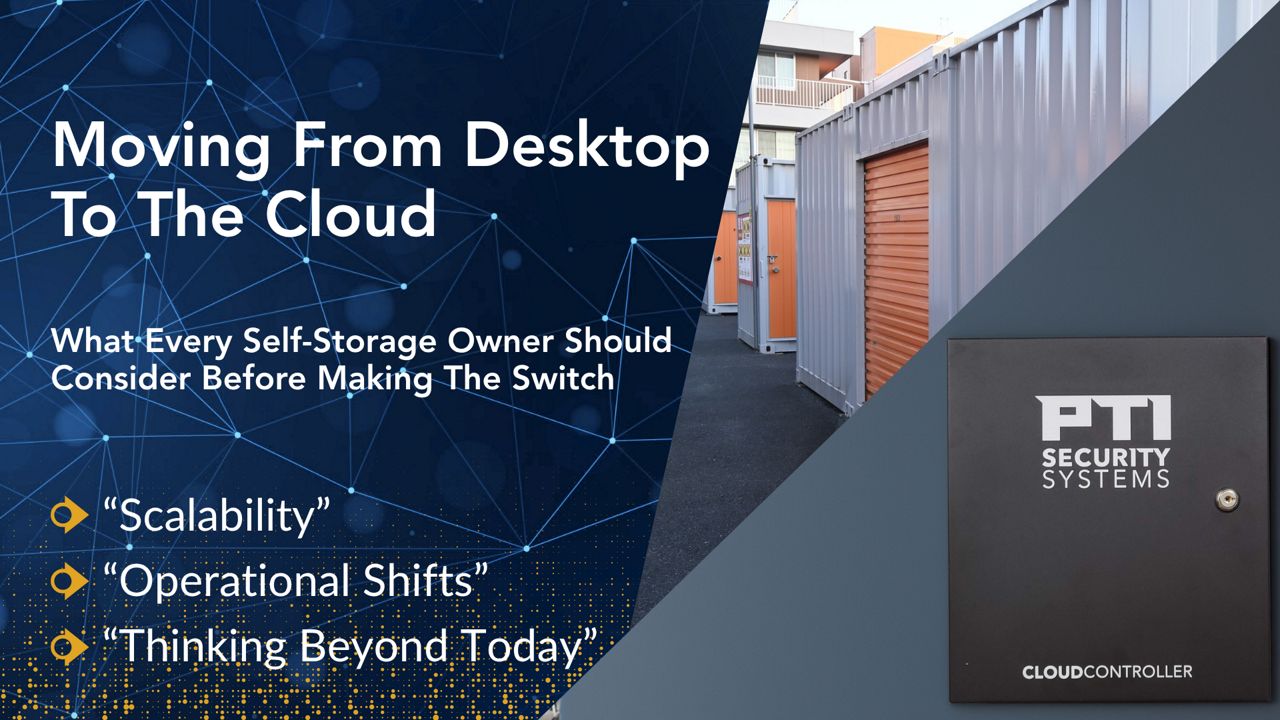
Historically, access control has been defined by desktop-based systems and has served owners and operators well over the decades. These systems have been entrusted with maintaining gates, doors, and facility access from within a site.
As needs evolved and self-storage operations became more connected, owners and operators recognized the need to move toward cloud-based systems that deliver a more modern experience. The question of when, not if, has been the overarching access-control question for many of these facilities that have successfully provided service to tenants for decades.
Aside from the costs alone, there are a number of things that should be considered in order to make an informed decision prior to moving away from the desktop.
It's More Than Just A Hardware Change
Moving to cloud-based systems is more than just a change in a facility’s hardware. In effect, it is a shift that impacts the entire operation and how it will be managed. Once deployed, operational changes in how owners and operators respond to site activities will need to be reviewed, along with the overall management of the facility.
But like all site owners, the question of moving to the cloud is not IF, but WHEN.
Remote Management – How It Changes Your Operation
The most basic reason for moving to a cloud-based access control solution, such as PTI Security Systems’ CloudController, is remote visibility and control over one or more properties. A single dashboard for multiple properties is extremely advantageous toward increasing efficiency and oversight as found in StorLogix Cloud.
Regardless of the number of facilities within a portfolio, a single dashboard allows an owner or operator to remotely control gates, manage credentials, receive and respond to alerts, view site activity, troubleshoot issues with a particular site, and more.
It’s No Longer Software, It’s A Foundational Platform
Today's access control systems connect to a range of peripheral devices but serve as the heart of any facility’s security solution. That said, when evaluating any access control solution, it is important to align a facility with a foundation that is extremely flexible and scalable and leverages integration options for various property management systems, smart latches, surveillance systems, and other automation tools.
Systems that can connect to multiple devices and vendors offer greater options for owners and operators when scaling later.
More About Scalability
Today’s single-site owner may tomorrow decide to invest in 3 or more facilities. Therefore, any cloud-based system must be able to scale with an owner’s portfolio while providing holistic oversight and granular, site-specific control. Additionally, the ability to provide roll-up or site-specific reporting is helpful toward evaluating a portfolio’s health or identifying a specific issue with a site.
The Importance Of Reliability
Desktop systems and cloud-based systems all have their dependencies, and both can be susceptible to a number of issues including:
· Internet interruptions
· Power disruptions
· Cellular backup failure
Since access control systems are the foundation to a facility’s operations, it is therefore critical that there is a fail-safe plan to address the above issues. For example, PTI’s CloudController will still operate a facility in the absence of internet and even power for 4 – 8 hours, which is often long enough for power to be restored in most situations.
Look Beyond Features And Consider Operational Impact
When thinking of moving to the cloud, it is far to easy to simply look at the features of any access control system and ignore how leveraging a solution like PTI’s CloudController and StorLogix Cloud will impact a facility’s daily operation and the overall tenant experience. As most self-storage facilities move toward automation, the shift to cloud-based access control systems often reduces manual administration. Typically, cloud-based systems also enable faster tenant onboarding with fewer manual touchpoints, centralized reporting, and more robust data to drive greater operational efficiency. The advantages are clear, but a facility must first be open to understanding the operational impact and be willing to change years of processes in order to take full advantage of the benefits of cloud-based access control solutions.
What About The Economics?
Migrating from a desktop solution to a cloud-based access control scenario does change a facility’s approach to expensing this critical aspect of their facility. More than likely, desktop solutions are often characterized by a one-time expense, whereas cloud solutions are subscription-based. And while this may be a difficult leap for some older facilities, an owner should also consider the expense that could be incurred when their desktop solution ultimately fails, whether due to hardware failures or to end-of-life scenarios where desktop solutions are no longer supported by the operating systems of the computers themselves. In addition, cloud-based systems like CloudController are updated frequently to maintain security, address maintenance issues, or add new features. Therefore, cloud-based systems are future-proofed against obsolescence and are, by definition, built to continue to grow with any facility.
Ready, Set Go!
Moving from desktop to any cloud-based solution should be approached with some planning. While the transition is typically fairly seamless, it is important to take into consideration
· Current hardware used within the facility today
· Training requirements for the staff
· Arrange for implementation specialist to be available during migration
· Plan for some downtime during the migration
· Roll out the benefits and uses for the more robust feature sets that cloud-based solutions in phases.
Final Thought
With today’s business climate and the increased need for automation, the question of moving to the cloud is not one of IF but WHEN. That said, approaching the migration in a pragmatic way will help ensure a smoother transition once an owner finally decides to move to a more modern approach.

2026-10-14

2026-09-22

2026-08-26

2026-08-04

2026-08-01

2026-07-14

2026-06-24